1st Interprovincial Generative AI day in Zwolle

How can AI be used in the professional field of the provinces? Developments in artificial intelligence are moving very quickly. It offers opportunities but also challenges. Experts from all twelve provinces shared their knowledge and experiences today at the first Interprovincial Generative AI day in Zwolle. An initiative from the Province of Limburg, the Province of Overijssel and the Interprovincial Consultation.

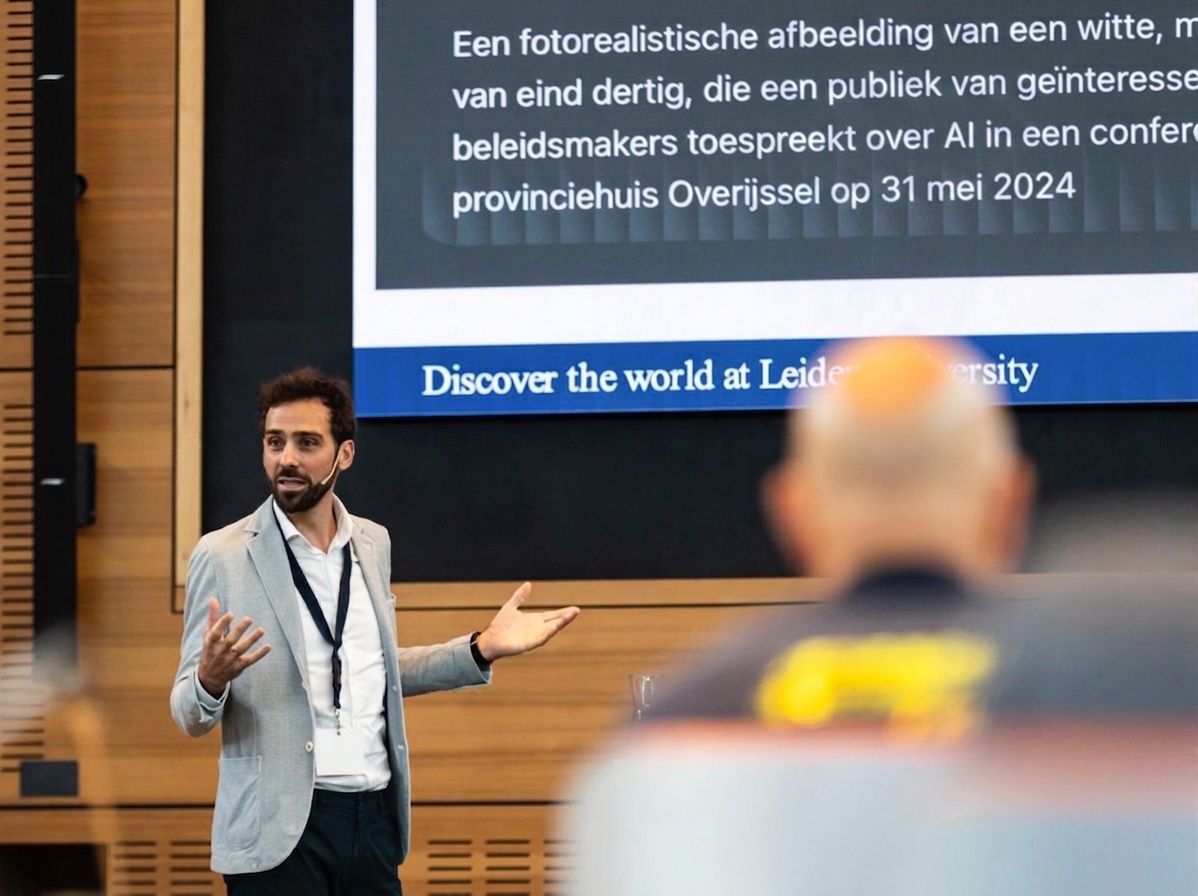
Max van Duijn was a keynote speaker together with Eric Postma and Anne Fleur van Veenstra. Max talked about the capabilities of systems such as ChatGPT and Google’s Gemini. Through recent research examples, he discussed whether these systems merely reproduce language structures or actually possess understanding, thinking skills and creativity. Implications for current and future applications of generative AI were discussed interactively with the audience.
Max van Duijn guest at podcast ‘Computers don’t byte’

S01 / E03: using language as a window on the mind

Assistant professor Max van Duijn combines cognitive science with Artificial Intelligence (AI). His research is on children’s stories and the question if they have a so-called Theory of Mind. This is the ability to understand the mental state of somebody else and use this information to explain and predict human behavior. 

But here’s the twist: Max’s research not only applies to the exploration of storytelling but also serves as a test for AI. With the data collection, he and his team investigate uncharted territory: Does AI possess a mind? Can entities like ChatGPT truly empathize? 

About ‘Computers don’t byte’

Computers don’t byte is a series by the Leiden Institute of Advanced Computer Science (LIACS). Leading computer scientists from a variety of fields share their expertise and insights. Dive into the minds of these researchers and learn about real-world applications, the future of AI and related technologies and cutting-edge research. From chatbots to cybersecurity, from quantum to children’s stories, each episode offers its own perspective on the changing landscape of computer science. Whether you’re a seasoned professional or an aspiring enthusiast, this podcast offers knowledge and inspiration.

PowNed: We Gaan Er Allemaal Aan

AI can do more every day than the day before, but no one can explain exactly how AI does what it does. In the new television program ‘We gaan er allemaal aan’ Valerio Zeno examines various disaster scenarios that could bring down humanity.

In the first episode, he examines the dangers of AI. University lecturers Maarten Lamers and Max van Duijn, both working at the Leiden Institute of Advanced Computer Science (LIACS), both shine their light on AI and its possible dangers. Can AI empathize with humans? Max van Duijn explains it using the Sally-Anne test.

Do self-improving machines pose a threat to humans? The answers to these and other questions are covered in ‘We gaan er allemaal aan’.

Watch the episode back on NPO Start.

Interview Leiden University

Children’s stories as a window to investigate empathy

Researcher Max van Duijn and PhD student Bram van Dijk apply language models to stories told by children to investigate empathy. For this research, they received the Best Paper Award at the Computational Natural Language Learning Conference in Singapore.

Read the full interview in Dutch here, or in English, here.

Best paper award @CoNLL@EMNLP in Singapore

Humbled to receive the best paper award @CoNLL@EMNLP in Singapore from programm chairs Jing Jiang and David Reitter for the Children’s Story Corpus we have been working on since 2019 in my Veni project at LIACS. It’s a pity Bram van Dijk wasn’t there as he did the majority of the work. Many, many thanks to the 442 children and their parents and teachers for sharing their stories with us and to all project assistants!! And to NWO (Nederlandse Organisatie voor Wetenschappelijk Onderzoek). Find the paper and the corpus here: https://aclanthology.org/2023.conll-1.23/